- Identity as a Researcher and Master’s Thesis
Borrowing Rodney Stark’s persepctive, I have sought to understand “how conceptions of God shape social life.” From my years in seminary through my master’s studies, I have been interested in how religious ideas, discourses, and communities (or congregations) shape and interact with social life. Drawing on my experience within Korean Protestantism, I have come to see group threat and boundary-making as central to many contemporary conflicts involving religion.
In Christian contexts, some conservative Protestant communities perceive growing social recognition of racial, ethnic, religious, and sexual minorities as a threat. In the United States, white Christian nationalist discourse often frames immigrants, racial minorities, non-Christian religions, and sexual minorities as threats to a Christian national order. In South Korea, some conservative Protestant movements similarly mobilize around perceived threats associated with Muslims, immigrants, communism, China, and the political left, including opposition to the anti-discrimination law (Korean: 차별방지법).
These movements often emerge from the perception that outside forces may corrupt or undermine an established sacred order. I became particularly interested in how such perceptions of threat lead religious communities to construct boundaries between insiders and outsiders, and how those boundaries can contribute to political mobilization. I first developed this question in my master’s thesis.
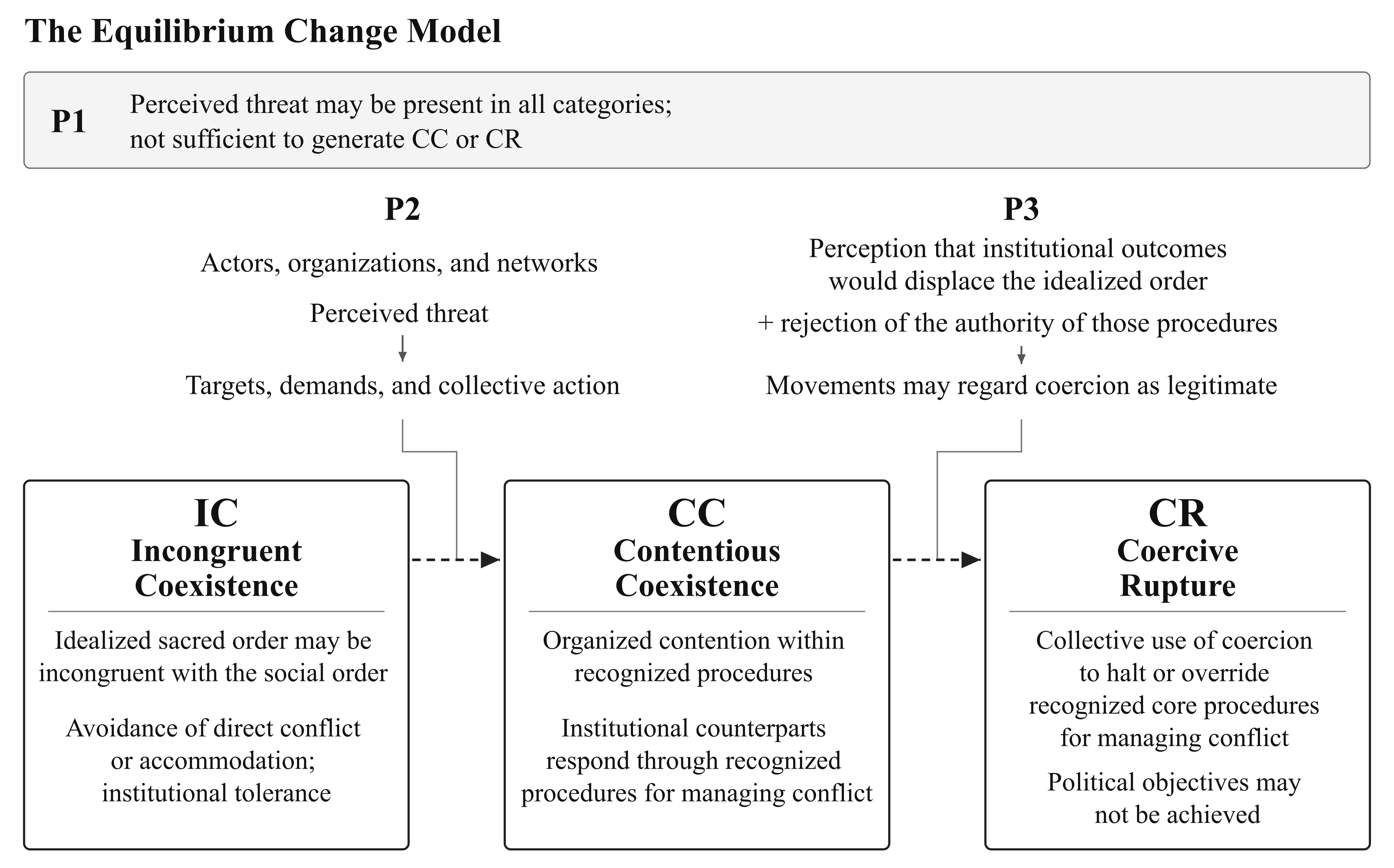
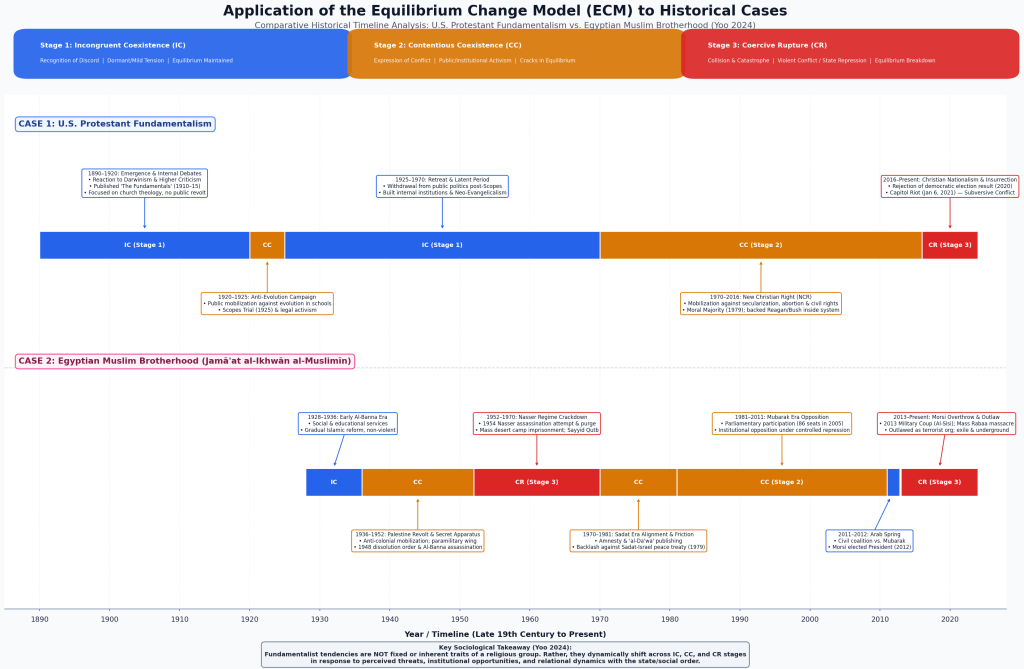
In my Master’s thesis, titled “Revisiting the Concept of Fundamentalism: Focusing on Changes in Equilibrium Relationships,” I critically reviewed research on “global fundamentalism” that uses a static or essential definition, which can overlook spatio-temporal dynamics. As an another explanation for fundamentalism, I proposed a more relational approach: the Equilibrium Change Model (ECM). This model is inspired by the theory of Martin Riesebrodt and David Bromley. To verify my approach, I examined historical cases from U.S. Protestant fundamentalism and the Muslim Brotherhood in Egypt.
- 2026 ISARS Poster Presentation_”Politicized Christian Discourses and Exclusionary Boundary-Making: The United States and South Korea in Comparative Perspective.”
You can download my Poster at ISARS 2026 below.
This research poster presents a comparative study of politicized Christian discourses in the United States and South Korea, focusing on how religious-political discourses build exclusionary boundaries of national belonging. Christian nationalism in the United States frames the nation as fundamentally Christian, links national identity to Christian national order, and often defines White-centered membership in exclusionary terms. In South Korea, some conservative and far-right Protestant discourses similarly portray the Republic of Korea through a distinctly Christian national narrative (Syngman Rhee‘s Christian Nation-Building Theory, 기독교입국론) and draw boundaries against groups perceived as religious, ethnic, or political threats.
Despite these parallels, the two cases are not treated as equivalent. While Christian nationalism has attracted significant scholarly attention in the United States, the conceptualization of comparable politicized Christian discourse in South Korea remains less settled. Addressing this gap, this study examines how the two cases define legitimate membership, construct perceived threats, and build exclusionary boundaries, while also attending to their different historical and political contexts.
Methodologically, the project draws on public rhetoric, organizational statements, movement texts, and media materials, together with published survey-based attitudinal data from the Baylor Religion Survey Wave VII and a 2025 South Korean survey of Protestant attitudes from the Christian Institute for the Study of Justice and Development (CISJD, 한국기독교사회문제연구원). Rather than directly comparing survey percentages across different populations and measurement frameworks, these data are used as contextual evidence for examining themes of threat, Christian national identity, pluralism, and exclusion. The comparison seeks to identify both recurring patterns and context-specific differences without assuming that the same mechanisms operate identically in each setting.

